Sunday, December 15, 2013

Our slowest Northern Saw-whet Owl season in 7 years!

Well this was a bit of a bust of a year for us, in terms of Northern Saw-whet Owl banding!  In total we banded only 45 saw-whets in 20 nights of banding, between September 20 to October 20.  Compared to our 6 year average (2006-2011) of 131 owls/season, this is significantly lower.  We typically stop banding around the end of October, but poor weather prevented us from opening after October 20! 
 
One neat bird was a recap by my sub-permit, Adam Crosby, captured on October 23, 2013, while I was unable to man the banding station.  The bird was wearing a band that had been placed on its leg at White-fish Point Bird Observatory on March 20, 2012 as a third year (TY) bird (in other words, it hatched in 2010)!  White-fish Point Bird Observatory is 11 mi north of Paradise, Michigan.

As you can see this is quite the distance between our two sites!  Our banding station, where we captured this owl is the green dot, while White-fish Point Bird Observatory is the red dot.  It is important to remember that this is not a direct band encounter.  The bird was banded at WPBO in spring 2012, bred somewhere in 2012, migrated south in the fall 2012, returned somewhere north in 2013 to breed and then passed through our area during the fall of 2013.  There is substantial evidence to suggest that saw-whets are fairly nomadic in terms of where they breed each year and this band recovery is somewhat suggestive of that idea.  In other words, the bird could have nested in northern Ontario in 2012, and then bred in northern Saskatchewan in 2013, but we don't know.  Based on a number of recaptures, we currently believe that saw-whets migrate in a south-east direction when moving through the prairies in Canada.  While these kind of encounters are really exciting, they end up generating more questions then they sometimes answer!

You can check out White-fish Point Bird Observatory's website here

Monday, September 30, 2013

800 Saw-whet Owls!

It has been a slow start to saw-whet banding here at Edenwold so far this fall.  Since we started 11 days ago, we have been able to open the nets on 6 of those days and we have only caught 3 owls thus far...

From discussions with Mike, in northern Alberta, and Harold, near Prince Albert, it sounds like Northern Saw-whet Owls did not do well raising young in their areas, likely due to a crash in red-backed vole numbers.  Both sites have only captured about a quarter of the owls they normally catch by this time in the migration! 

So that does not bode well for us further south here.  But only time will tell what flies our way!

Of interest though, the second owl we caught this year was a milestone bird!  It was the 800th saw-whet we have banded at our farm since beginning to capture saw-whet here in 2006 (in 7 years)!
We can't believe we have captured so many of these charming owls over the last 7 years!
The 800th Northern Saw-whet Owl captured at our banding station on Sept 27th, 2013.

Monday, September 23, 2013

Northern Saw-whet Owl Banding continues in 2013

In 2012, with 5 month old twin boys at home, Kristen and I decided to take a break from northern saw-whet owl (NSWO) banding during the fall migration...  
We had captured and banded saw-whets at our farm, from 2006 to 2011!  In the coming weeks I will post some of the results from those 6 years of banding. 

Today I want to let you know that we are back at the owl banding for the 2013 fall!

NSWO banding at our farm (just north of Edenwold, Saskatchewan) begins each year around Sept 20th and continues until the end of October.  This year, I believe, we are one of 4 stations being operated in the province.  The others are near Kyle, Saskatoon and Prince Albert.

This is a panoramic of where are owl nets are located.  Click on the photo to see the whole photo.

On Friday last week, my boys and I pulled out the mist nets and patch some of the holes in the nets.  We mowed the net lanes and got the nets all set up.  I was surprised to find a few things had changed since we'd last banded at this location in 2011, including a few downed trees that were important for anchoring our nets.  Nevertheless, to keep consistent between years, we set the nets up in the exact same spot each year.
Rowan and Teal helping to set up the owl mist nets.
 
With everything set, we began the owl banding season on Friday at dusk (Sept 20).  It is such an amazing experience, with life being so busy, to stand still and quietly as the world around you is enveloped in darkness.  Sounds are magnified tremendously.  One could be convinced that that snowshoe hare moving through the bush, is actually an angry raging bear! lol.

I was pleased to hear and then see our resident short-tailed weasel who has lived in our yard for many years (and in our garage during the last 3 winters)!  I wish I could band that guy to see if it is actually the same animal.  We have never lost an owl in the nets, so really have no concerns about this guy. 
On the other side of the nets, I was also greeted by a long-time friend, who we affectionately refer to as "Ruffy", our resident Ruffed Grouse.  Ruffy has had a drumming log on both sides of the nets over the last 7 years and is always present during saw-whet banding!  Again I wonder if this could be the same bird who was there when we started this crazy project!

Alas, Friday evening resulted in no owls captured.  The wind picked up to 20 km/hr from the southeast shortly after we opened.  Saturday saw wind gusts of 40-60 km/hr over night so we did not open the nets.

Sunday evening, saw our first owl hit the net!  So that's one so far.  We will see how many owls come through our farm this fall! 
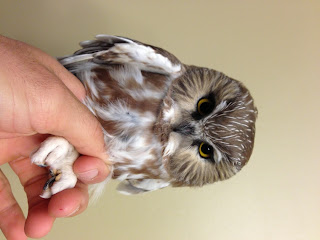
First Northern Saw-whet Owl banded fall 2013 near Edenwold, SK
 
Because I am back at school again this fall, we will try to be a bit sensible about when we close nets.  As long as weather permits, the nets are opened at dusk and will stay open until 11:00pm or midnight.  Unfortunately we can not band all night. :(

Thursday, September 5, 2013

Ferruginous Hawk Recovery

Well much has changed since I last posted on here!  Kristen and I have been busy on our farm this past year and our 16 month old twin boys have been keeping us that much more busy!

You may have noticed that my profile has changed.  As of the end of August I am no longer with Wascana Centre Authority.  I have decided to go back to school to complete a 2 year after degree program in education.  Don't worry though!  I will still be heading up the Wascana MAPS station and continue with many of our bird banding projects! lol... like you were worried.

On to the birds and the subject of this post.  I recently received a band report from the Canadian Wildlife Service.  On this report was a recovery of a Ferruginous Hawk.  What was interesting about this report was that the bird was still alive.

I had to find out what was happening with this bird, so I contacted the band reporter Diana Miller.  She is the director at the Nature and Raptor Centre of Pueblo, in Pueblo Colorado.

She informed me a female Ferruginous Hawk was submitted to them at the Centre on January 7th 2013, after being struck by a vehicle. 

Female Ferruginous Hawk injured at the Nature and Raptor Centre of Pueblo, in Pueblo, Colorado

Here is an excerpt from my correspondence with Diana:

"Yes, the ferruginous hawk is still alive.  She is a very big, beautiful girl.  Until she took a frontal assault from an auto she was thriving.  We received her at our center on January 7.  Her admission weight was 2.034 kg.  She was recovered along a highway in Fremont County, Colorado.
 
Upon admission she had extensive bruising to the chest and abdomen, a large laceration on the left side of her neck and chest, and internal injuries.  The veterinarian also found that her breast muscle on the left side was damaged and torn from the bone.  Her first few days were touch and go, but by the 6th day she was up, eating and ready to kill us all!  At this time she has moved into our large flight enclosure and is flying.  We are still dealing with the laceration.  Because of its location, it has been slow to close, and the stitches keep tearing out.  We caught her Sunday to check on the  wound’s condition.  It’s looking better, but I did clean it up and put in a few stitches.  It will be a few more weeks before it heals completely.  The muscle has healed well however.  Her flight is improving, but she is nowhere close to release at this time.  Her extension is good, but her endurance is poor.  I’m afraid that she will probably be with us for the summer."
 
After checking my records I found we banded this bird in June, 2009 a few miles southwest of Herbert, Saskatchewan.  That makes this girl just about 3.5 years old when she was turned into the raptor centre.  Here is a map of where this bird was banded near Herbert, Saskatchewan (2009; green dot) and where she was found hit by a vehicle near Pueblo, Colorado (2013, red dot).

What was most interesting was that this bird was colour banded with one of our blue alpha-numeric bands.  This is one of the very few resightings we have had.  Here are her bands after 3 years.
 
 The Nature and Raptor Centre of Pueblo hopes to release this beautiful hawk in the future.  What an amazing bird.

Check out the good work the Nature and Raptor Centre of Pueblo by visiting their website http://natureandraptor.org/.  Thanks for all you do!
 

Tuesday, June 19, 2012

1st Wascana MAPS session of the season!

So here we are already half way through June!  Amazing how time seems to fly.
As an update to the Snow Bunting post made months ago, the snow never really materialized here in Saskatchewan in certain spots and we therefore did not have the opportunities to catch Snow Buntings!  Zero SNBU captured... Alas we await the snow... but hopefully not that soon.

However, on June 12th, 2012, myself along with a dedicated crew of volunteers got the mist nets open for the first session of the Monitoring Avian Productivity and Survivorship station in Wascana Centre.  This is the third season that we have been running this program in the Habitat Conservation Area within the Centre.
(Bob fixing up one of the mist nets)

It was a fun morning with 51 new birds captured and banded, as well as 5 recaps (birds that already had bands on their legs, from previous years).  Here is the list of species and totals from Tuesdays banding.  To see the banding results from 2010 & 2011 check out Wascana Centre's website.
Species
Banded
Recap
Red-winged Blackbird
12
Yellow Warbler
9
American Robin
5
1
American Goldfinch
5
1
Gray Catbird
4
2
Common Yellowthroat
3
Cedar Waxwing
2
1
Clay-colored Sparrow
2
Song Sparrow
2
Brown-headed Cowbird
2
Warbling Vireo
1
Brown Thrasher
1
Common Grackle
1
Savannah Sparrow
1
Marsh Wren
1

Pictured above is the male After Second Year American Goldfinch that was already sporting a band when it was captured in the net.  This bird was originally captured on June 14, 2010 in the Habitat Conservation Area on our very first session of MAPS in our first year.  It was captured in net 8 in 2010, and captured in net 9 in 2012.  This bird was aged as an ASY in 2010, making it atleast 5 years old! 

Another one of our recaptures was a Gray Catbird, that was banded on August 3rd, 2011 as a recent fledgling.  When we captured it on Tuesday last week, it was sporting a rather large cloacal protuberance - suggesting that it is an actively breeding male this summer! 
Here's Duncan with a Cedar Waxwing.


  An adult male Savannah Sparrow.  Only the second SAVS captured during MAPS (2010-2012).
Our next banding session is scheduled for later this week. 

Friday, December 2, 2011

Snow Bunting Banding

This summer Oliver Love sent out a request for volunteer bird bandings to help study Snow Buntings across Canada this winter. Of course, without many birds to band around here during the winter, I have jumped at the opportunity. We are still waiting for a bit of snow around here before we start heading out, but I thought I would just post a bit information on the Snow Bunting.

The Snow Bunting is a small passerine that nests in Canada's Arctic. It comes down to Saskatchewan during the winter in small to very large flocks. The bird is easily identifiable with its white body and black back, wings and tail. While in flight the bird is easily to ID with its long black and white wings.

Oliver and his team of student researchers have been working on Snow Buntings on Canada's East Bay Island. Since 2007 his team have banded an amazing 1000 Snow Buntings on this tiny little island in the Arctic. They have also been doing some really amazing research using geolocators, colour banding and sound recording devices. They are studying signals of male quality, mating strategies, reproductive physiology and the migratory connectivity of the Snow Bunting population on East Bay Island. For more information on all of this research, check out the first "Snow Bunting Report" published by Oliver and his crew earlier this week. Some fascinating information in here.

You can also check out the Canadian Snow Bunting Network website.

We'd also like to thank Sun Country Farms in Langham, SK for their help in acquiring the feed we need to catch the birds. Thanks Sun Country Farms! :)

I look forward to posting once we start catching some birds!!