Tuesday, February 17, 2009

A Northern Hawk Owl Bonanza

Yesterday, Kristen and I decided to use our family day to go for a drive. Just how far we were going to drive we didn't know, we just knew that we wanted to see an owl of the north.
So we set out at 6:00 am, so we could be in the northern country before noon.

To give a way a bit of the story to begin with, we travelled 1,050 km and made it home to Regina by 10:30 pm. We only spent half an hour out of the vehicle during that time!
It wasn't until we had been searching for four hours, driving for 6.5 hours that we found our first owl, a Northern Hawk Owl! Only the third hawk owl I have ever seen. Kristen spotted it as we cruised along the road. We stopped, and reversed, just in time to see the owl take off, bee-lining it for a large spruce tree. It shot out its legs and tried to take something out of the tree. It dropped down into the bush below, and we never saw it again! Even though it was a quick sighting, we were pleased to have even seen an owl after six hours of driving.


We continued on our way and soon enough (~15 km) we had found another Hawk Owl! We couldn't believe it! This time he sat tight and allowed us to get all set up.

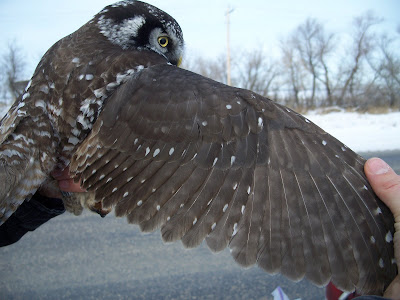
After a little while we had this amazing little owl in our hand!

Onward we went after letting this one fly off, which you can see here.


Our luck was absolutely amazing, we came across not 2, not 3, not 4, but 5 more Hawk Owls during the course of the day!!! We found 7 hawk owls in total. We were absolutely giddy with our luck. There was one slight cause for disappointment (if I'm even allowed to be disapointed after finding 7 Hawk Owls). We had only received three bands specially sized for Hawk Owls before we left on our little impromtu trip and therefore could only band the first three hawk owls. So we only could look at the last 3! I had mentioned prior to our trip to Kristen that I hoped we could find atleast one owl during our trip. I would not have imagined we would find 7, so wouldn't have thought to bring more. Oh, well, we did get 3!

Once in the hand, we weighed the birds and took measurements of the wing chord, tail and culmen. We also assigned an age to it, based on similiar features of the saw-whet owl which I have discussed here before. With a new band around their leg, they are quickly back to hunting for mice in the snow.


Hawk Owls and Great Grays are highly adapted to catching mice and voles during the winter. We watched a hawk owl yesterday hovering over a bank of snow, and instantly dive deep into the snow, leading with its outstreched talons. He sat there for a second like a toddler that has just been thrown helplessly into a deep snow pile. Then he sprung out of the snow, empty handed and kept on hunting. Most of the time, Hawk Owls use their speed to catch their prey, by plucking them off the ground. These things are amazingly fast, thanks to their more hawk-like wing (better adapted for speed and actually not silent like other owls), which are so fast in fact that the poor little mouse really doesn't have a chance once these owls have them in their sights.
All in all it was a fantastic day! We notified Harold of the 3 owls we saw but did not have bands for, so hopefully he will make it out and find them. Interestly, we didn't see a single Great Gray Owl during the course of our 1000 km trip. Ironically, Harold Fisher tells me he has only seen 3 Hawk Owls in his area this entire winter, so we were very lucky!

Wednesday, February 11, 2009

The Mystery of the Banded Tropical Mockingbird

Now don't get all excited, no one in Saskatchewan has seen a Tropical Mockingbird. I thought I would share this neat story, because I learned something about banding in North America from it.
I recently was in Mexico for a family vacation. We stayed at a resort south of Cancun on the Yucatan Peninsula. It was amazing to see so many tropical birds, from Magnificent Frigatebirds, Great Kiskadees, Yucatan Jays, to Squirrel Cuckoos. It was also a real treat for me to get to see some of the warbler species we see in Saskatchewan during the breeding season, but there they are on their wintering grounds. We saw Black-and-white, Magnolia, Yellow, Common Yellowthroat and American Redstarts.

One bird that was ubiquitous everywhere we went was the Tropical Mockingbird (TRMO)! This bird is slightly different from the Northern Mockingbird folks here in SK might be familiarly with, but not much at all.
These guys were everywhere around our resort!
One morning as we were leaving the restaurant area, we noticed a TRMO sitting in a tree. We had our binoculars with us, so had a look at the bird. Well, to our surprise it was wearing a band around its leg!!! I couldn't believe it! What are the chances!?!?!

(Can you see the band on the birds left leg?)

We observed the bird for a few moments and then carried on.

Being slightly obsessed about banding, Kristen and I decided to go back a few days later and see if the bird was still around. We had noticed that TRMO's seemed to stay in the same areas each day, likely individuals on something of a territory.

Sure enough the bird was right in the same place as we had seen him three days prior.
This time we had brought the spotting scope. Miraculously, the bird sat in the same spot for 15 minutes as we made a 360 degree circle around it with the spotting scope and read the band combination right off the band.

To our surprise, the band number included letters - "RSK4557" to be exact.
We recorded all the pertinent data - location, data, status of the bird - and continued on our way.
Once we returned to Regina the next day, the quest to find where this bird had been banded was on!

I started by contacting the bird banding office to see what they could tell me. Interestingly, I found out that the BBO does not supply Mexican banders with bands for birds that do not migrate into Canada or the United States. Therefore Mexican banders must have the bands they are going to use on tropical resident birds (like Tropical Mockingbirds) custom made. Therefore, the BBO does not have any record of this band, since it is not a BBO band. They tried to do a search for a bander who might band migrant birds in that area, but with no luck. So how am I suppose to find the mexican bander who banded this bird if the BBO doesn't know!?

Luckily, a friend of mine, Steve Davis, who works for Canadian Wildlife Service was in Mexico the week after I arrived home! He was actually teaching Mexican banders how to catch and band grassland songbirds. I quickly sent him an email, unsure if he would have internet access where he was. Thankfully, he did! He passed the information onto his collegues and they responded with two possible emails for me to contact.

Unfortunately, I have not heard anything back from the two organizations who I sent the banding information to. So as it stands I do not have the mystery solved. Hopefully something comes through soon! I couldn't believe that on my trip to Mexico I would find a banded bird!
If I solve the mystery of the banded Tropical Mockingbird, I will surely post the answer here!

Wednesday, January 28, 2009

Recapturing a Banded Great Gray!

We were very excited when we captured our first Great Gray Owl with Harold Fisher this past weekend. We were even more excited when we realized it was already banded! We were then even more excited when we found out when and where this bird was originally banded!

This girl (we think), weighed in at 1274 g, with a wing chord length of 441 mm.

Can you see in the picture how some the flight feathers (the largest feathers on the wing used to fly) are different shades of grey, some are even brown? This means that this bird has different generations of flight feathers, which is a technique that is used to age certain species of birds (this has been mentioned before with saw-whets).

Based on the number of feather generations in the wing of this bird, we estimated that this bird was atleast 3 years old.

Well, were we surprised to find out later that day that this bird was originally banded on 24-Feb-2001! That would be eight years prior to our capture of her. Because she was aged as atleast one year old when she was first caught, we know that this bird is atleast 9 years old! The oldest longevity record for the Great Gray Owl is ~12 years.

Interestingly, she was captured initially only 64 km S of where we captured her!

Recaptures like this are what researchers like Harold are looking for. This data will help us understand movement patterns of these owls between seasons (many seasons in the case of this individual!) and understand population dynamics (how old birds live, the proportion of young birds captured versus older birds captured, etc). It was fantastic to be part of this find!

A Great Gray Experience!!

Great Gray Owls are one of the most majestic birds on the planet, if you ask me, and it wasn't until just this past weekend that I actually got to see one in the wild!
We joined Harold Fisher of Prince Albert (a local raptor bander) for the weekend as we toured around the countryside to find these huge owls as part of an ongoing banding project. For a number of years now raptor banders have been catching and banding Great Gray and Northern Hawk Owls in the boreal forest in an attempt to learn a little bit about these elusive owls.


Harold did not let us down - on our first day we located 4 Great Grays!!

Of these 4 owls we were able to capture 2 Great Gray Owls, plus 1 Northern Hawk Owl - according to Harold this is a good catch in one day! You can drive for hours and hours and not find an owl. Once in the hand, the birds are banded, weighed, measured and photographed. And then quickly released, take a look at Kristen's first time release.


Great Gray Owls hunt primarily small mammals (mice and voles) during the day. You'll notice these owls have very large facial disks (the circular shape around the eyes), which aid in focusing sound into their ears (cup your hand over your ear, you notice you can hear better? This is what the facial disk does). Because of this adaptation Great Grays can hear a mouse below the snow, dive in without ever seeing the mouse and come up with a delicious meal!

While they appear large (they are the largest owl in North America), they are not the heaviest on the continent (Snowy or Great Horned Owls take that prize). Great Gray appear so big because they have so many feather to help keep them warm during the cold winter up north. In the picture below you can see Kristen's hand holding onto the birds legs (the safest way to hold the owl, both for the handler and the owl) - the hand in the glove is actual cold, while the hand tucked up in the owl's feathers are amazingly warm and toasty!


It was amazing to get to see a Great Grey Owl finally! It was even more amazing to get to handle one of these impressive raptors. In the hand, the Great Gray is as docile as a bird can be!

Thanks to Harold, Denise, and Shelley we had a great experience!

Sunday, November 30, 2008

Reporting banded birds

I thought this would be a good time to post about reporting banded birds.
It's really quite simple.

(Young Burrowing Owl chick)

If you find a banded bird you should record the following data:

1) The date you found the bird
2) The band number
3) If you know it, the species
4) The location you found it, as specifically as possible
5) If the bird is dead, how you think it died (ie beside road - hit by a car, below powerpole - electrocuted)

Once you get home you can go to this webpage http://www.reportband.gov/ and report the details here.

This website is regularly being update - just recently they have made it possible for the band finder to input the exact GPS location of where you recovered the bird (in any format UTM, or lat long (decimals degrees, deg min sec)) so if you have a GPS record the location.


(You can also record colour bands to the webpage or phone number. This is a Ferruginous Hawk chick with a blue band along with its aluminum band)

You can also call in the band information by calling 1-800-327-BAND.

(This Burrowing Owl was found just east of Regina near Monica Slough. It has a colour band on its left leg. 83 over M - red band, white letters. It was banded near Milestone the year before it was seen here. You might also notice it has a syringe infront of it... we may have found the reason why burrowing owls are declining so quickly...)

Monday, November 24, 2008

Saw-whets done for another year!

I can't believe how quickly time flies when you are having fun! We have already completed the third season of saw-whet banding at Edenwold SK! Once all the birds were tallied we captured 157 at my Edenwold site. Kristen, 5 km SE of my site capture 74 owls and Adam at Craven captured 16 owls! I think it is absolutely astounding how many of these small little owls move through the Regina-Edenwold area and no one notices! There has not been a single report of a Saw-whet from anywhere around Regina yet this fall or winter.

We did capture a few birds that were already banded this year at my site. Two of these were banded at the North end of Last Mountain Lake by Mr. Ross Dickson. Another bird was banded by Mr. Dan Zazelenchuk near Kyle, SK. All three of these were banded this year and moved directly to my station. I also captured a bird that was banded at my station in 2007, 3 days less exactly a year.
Kristen did not capture any birds that were banded at more distant stations then mine, but she did capture a few of my birds. Three of these were banded this year and recaptured in her net a few days later. But one of these was another bird from my station, banded in 2007.
It was a good year altogether! Now only 309 days until we start again!